Short answer: yes, a franchise business Gold Coast is still very much worth a look in 2026. We say that with a bit more confidence than usual, too — the numbers behind it are genuinely good. The city’s population has crept up to roughly 741,661 people this year, close to 2% growth in twelve months (World Population Review, 2026), and 2025 delivered a record $8.9 billion visitor economy off the back of 14.4 million visitors (Tourism Research Australia, via Experience Gold Coast, 2025). Throw in the $7 billion-plus being spent on Brisbane 2032 Olympic infrastructure across South East Queensland, new housing pushing out through Coomera and Pimpama, and retail and services demand that just keeps climbing, and it’s not hard to see why so many people are eyeing franchise opportunities Gold Coast-wide right now. If you’ve been quietly weighing up a profitable franchise business, this is a fairly good moment to stop sitting on the fence.
There’s a reason the franchise model keeps winning over first-time business owners: it takes some of the guesswork out of starting from zero. You’re buying into a brand people already recognise, a system that’s (hopefully) been refined over years of trading, and a level of support you just don’t get if you go it alone.
franchise business Gold Coast options aren’t exactly in short supply — the harder part is knowing which one actually suits you, your budget and how hands-on you want to be. So we went back through our original list, checked every stat and franchise fee against what’s true today, dropped the ones that no longer stack up, and added a couple of newer names worth knowing about. Here’s where things stand for 2026.
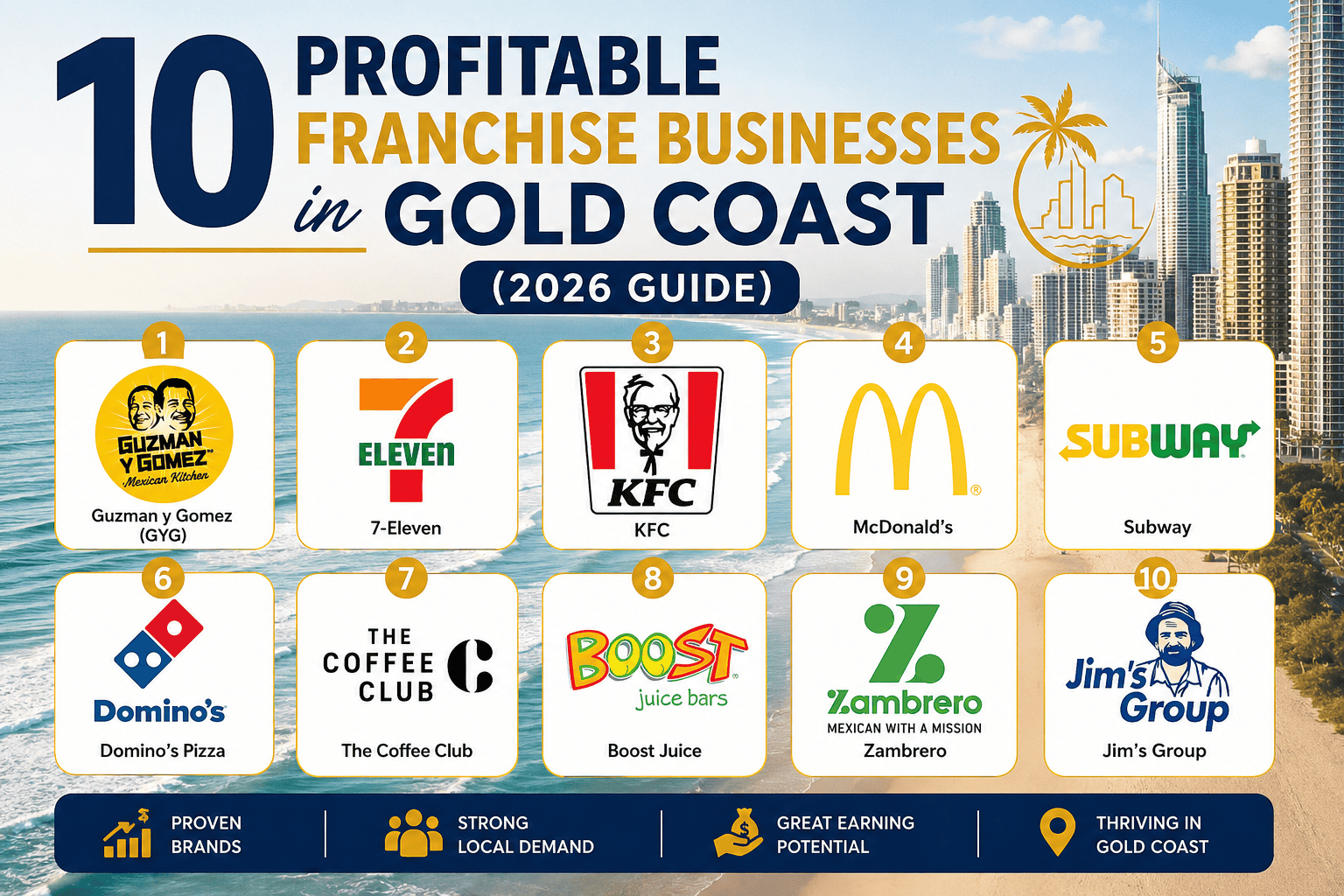
Top 10 Franchise Opportunities in Gold Coast for 2026
1. Guzman y Gomez (GYG)
If you only read one entry on this list, make it this one. Guzman y Gomez (GYG) has gone from scrappy Mexican upstart to one of the biggest success stories in Australian franchising, and the 2025 numbers back that up: 237 restaurants nationally by year’s end, global network sales up 23% to $1.18 billion for FY25, and — this is the number that really jumps out — a median franchisee return on investment of around 50% (GYG FY25 results, ASX:GYG, August 2025). That’s not a typo. If you’re chasing a genuinely profitable franchise business in Gold Coast, GYG is doing something right that most QSR brands aren’t.
It’s not cheap, though — a drive-thru site will run you somewhere between $650,000 and $1,000,000, so this one really suits an experienced, well-funded operator rather than a first-timer testing the waters. And a quick honesty check: GYG’s share price has bounced around a lot since listing, so don’t confuse the company’s stock performance with how well an individual store actually does — they’re two different things.
2. 7-Eleven
7-Eleven barely needs an introduction. It’s Australia’s biggest convenience chain by a wide margin — about 33.5% market share — and now runs more than 700 stores nationally. In a move that flew under the radar for a lot of people, the Australian arm was bought outright by 7-Eleven International (part of Japan’s Seven & i Holdings) back in April 2024 — worth knowing if you’re wondering how stable the parent company is. The stores themselves still punch through roughly seven customers a second across the network, which tells you a lot about how deeply this brand is woven into everyday Australian life.
Cost-wise, you’re looking at $400,000 to $1,000,000-plus depending on the site and whether fuel’s part of the deal. It’s a gross-profit-share arrangement rather than a straightforward franchise fee, so it suits investors who are already comfortable reading that kind of agreement — this isn’t really a franchise business Gold Coast newcomers dip a toe into lightly.
3. KFC
Depending who you ask, KFC is Australia’s number-one franchise, full stop. There are around 750 stores nationally now, and Collins Foods — the biggest franchise partner — runs close to 292 of them, adding a net 29 new sites in 2025 alone. The buckets, burgers, sides and desserts formula hasn’t changed much, which is sort of the point — Australians know exactly what they’re getting, and that consistency is worth more than any menu gimmick. KFC also puts real money behind hunger-relief and youth education programs, for what it’s worth.
You’ll need serious capital here — think $1.5 million to $2.5 million-plus, with a franchise fee around $45,000 on top. This one’s really for operators who’ve already run food-service businesses at scale, or who’re stepping into a multi-store deal rather than a single first shop.
4. McDonald’s
There’s not much left to say about McDonald’s that hasn’t already been said — it’s the most recognisable fast-food brand on the planet, and it’s still growing here. Australia currently has around 1,073 restaurants, roughly 85% franchised, and up to 50 new sites are planned for 2026 — not the behaviour of a brand that’s slowing down. It remains one of the profitable franchises Australia has going, mostly because it never stops tinkering with the menu and never lets service standards slip.
This is the most expensive option on our list — expect to put up somewhere between $1.2 million and $2.6 million once the site and build costs are in. Not for the faint-hearted, but arguably one of the safest bets going, given how much of Australia’s fast-food spend it soaks up year after year.
5. Subway

Subway is everywhere — that’s really the story here. It’s built a reputation on customisable, marginally-healthier fast food, and its franchise fees have traditionally been lower than most of its rivals, which is part of why so many best franchise business Australia searches lead people here first.
It’s still Australia’s biggest QSR by store count, with around 1,232 locations as of 2024. A single store typically costs between $150,000 and $500,000, plus a $15,000 licence fee — reasonable enough on paper. The catch is the ongoing fees: combined royalty and marketing charges sit close to 12.5% of sales, noticeably higher than most brands on this list, so it’s worth modelling that against your expected turnover before you sign anything. Store saturation is the other honest caveat — with well over a thousand locations already, finding genuine whitespace on the Gold Coast takes some digging.
6. Domino’s Pizza
Domino’s Pizza franchisees get a genuinely solid setup: proper training up front, ongoing marketing support, and the franchisor handling a lot of the annoying logistics — site approval, equipment installs, that kind of thing — which takes real risk off your plate compared with building a food business from scratch.
That said, let’s not pretend it’s all smooth sailing right now. In February 2025, Domino’s Pizza Enterprises closed 205 underperforming stores worldwide — including several across Australia and New Zealand — as part of a broader profitability push, and by late 2025 a group of Australian franchisees was openly pushing back on the fee structure. None of that erases the fact it’s still the country’s biggest pizza chain by a wide margin, but it’s a system going through some growing pains, and you should walk in with eyes open rather than nostalgia for the brand.
Set-up costs land in the mid-six-figures depending on site and format — best suited to someone who’s run a food business before and isn’t easily rattled by a franchisor tightening the screws on underperforming stores.
7. The Coffee Club
There’s a nice bit of origin story behind The Coffee Club: back in 1988, founders Emmanuel Kokoris and Emmanuel Drivas went out one night looking for a decent coffee, came up empty-handed, and ended up talking for hours about building somewhere Australians could actually gather over a good cup. That idea’s held up remarkably well.
These days the brand runs around 250 stores across Australia (400-plus globally under parent company Minor DKL), and it’s kept its footing in a café market that’s only gotten more crowded. Setup runs roughly $375,000 to $595,000-plus — this one suits someone who genuinely wants to run a full café, table service and all, rather than a grab-and-go kiosk. The systems behind it are decades-deep at this point, which counts for a lot when you’re new to hospitality.
8. Boost Juice
Boost Juice has been running on its “Love Life” philosophy since 2000, and honestly, building it into one of Australia’s most recognised brands took a fair bit of grit rather than luck — it wasn’t a given back then that a juice bar could become a household name.
It’s now sitting at more than 350 outlets across around 13 countries, all franchised through parent company Retail Zoo. Getting into one costs $220,000 to $350,000-plus, with royalty and marketing fees adding up to roughly 11% of sales. It’s a good entry point for someone new to franchising who wants to ride the ongoing health-and-wellness wave without the complexity of a full kitchen.
9. Zambrero

New to this list, but it deserves the spot: Zambrero is Australia’s biggest Mexican QSR brand, and it’s been quietly building serious momentum. Founded in Canberra back in 2005 by Dr Sam Prince, it now runs more than 200 restaurants nationally (300-plus worldwide), with a kitchen model that skips the deep fryer entirely — simpler to run, and it fits neatly with where fast-casual eating is heading. There’s also its well-known “Plate 4 Plate” program, which donates a meal for every burrito or bowl sold — not just a nice story, it’s a genuine point of difference with customers.
Investment sits around $350,000 to $650,000-plus, plus a roughly $30,000 franchise fee, a 7% royalty and a 3% marketing levy. It suits an owner-operator who wants a values-driven brand and a kitchen that’s genuinely simpler to run day-to-day than most QSR formats — and one of the more compelling franchise opportunities Gold Coast has seen land on this list.
10. Jim’s Group
Also new here, and worth it if your budget’s a lot smaller than the rest of this list: Jim’s Group is Australia’s biggest home-services franchise network, covering more than 50 divisions — mowing, cleaning, pest control, dog washing, you name it — with over 5,700 franchisees across the country. Given how fast the Gold Coast’s outer suburbs like Coomera and Pimpama are filling up with new households, this is arguably one of the best-timed entries on this list.
You can get started for as little as $13,000, up to around $60,000 or so depending on the division — a fraction of what you’d need for any of the food-based franchises above. It comes with an income guarantee and a constant supply of leads (Jim’s reports well over 200,000 unserviced leads a year), which makes it a genuinely sensible option for a first-timer or someone testing the water alongside another job.
Also Read:
Top 10 Small Profitable Business Ideas In Australia
Australian Startup Ecosystem 2025: Sydney vs. Melbourne and the Rise of Deep Tech Investment
Why Australian Small Businesses Are Failing In Early Stages
Franchise Cost in Australia (2026): What to Budget For
One of the questions we get asked most is simply: how much money do I actually need? The honest answer is “it depends enormously,” but here’s a rough breakdown of where things sit across the market right now:
| Investment Level | Estimated Cost (AUD) | Suitable For |
|---|---|---|
| Low Investment | $13,000–$100,000 | Home services, cleaning, mobile and mowing businesses (e.g. Jim’s Group) |
| Medium Investment | $150,000–$650,000 | Cafés, juice bars, QSR and fitness franchises (e.g. Boost Juice, Zambrero, The Coffee Club) |
| High Investment | $1,000,000+ | Major fast-food and convenience formats (e.g. McDonald’s, KFC, 7-Eleven fuel sites) |
Worth flagging: these are ballpark 2025/2026 figures pulled from franchisor materials, Franchise Council of Australia data and franchise marketplace listings, not gospel. Always get the exact numbers from the brand’s current Disclosure Document before you commit to anything.
Final Thoughts
At the end of the day, franchising is still one of the more sensible ways to get into business for yourself without doing it entirely alone — you’re borrowing a brand people already trust and a system that’s (usually) been stress-tested by hundreds of other stores before yours. Starting a franchise business Gold Coast locals will recognise doesn’t mean skipping the homework, though. Franchise agreements can be genuinely complex, so it’s worth getting a franchising lawyer to walk you through the fine print before you sign — they’ll help you understand exactly what you’re committing to, and there’s no shortage of horror stories from people who skipped that step.
For more business news out of Australia, head over to our Business section.
Frequently Asked Questions
What is the most profitable franchise business in Australia?
There’s no single winner here, but QSR brands with strong unit economics tend to top the pile — Guzman y Gomez, for instance, reported a median franchisee ROI of around 50% in FY25, which is exceptional. Home-services and NDIS-adjacent franchises are also worth a look, since lower overheads and steady demand make them surprisingly resilient.
How much does it cost to buy a franchise in Australia?
It really depends on the category. Home-service franchises can start from around $13,000–$20,000, cafés and QSR brands usually land between $150,000 and $650,000, and the big fast-food names like McDonald’s or KFC can run past $1–2.5 million once you factor in the build and fit-out.
Which franchises are best for first-time business owners?
Go for something low-cost and systemised, with solid training and leads already built in — Jim’s Group divisions are a good example, or Boost Juice and Zambrero if you’d rather have a physical storefront with heavy franchisor support. These setups take a lot of the guesswork out of your first year.
Is buying a franchise in Gold Coast a good investment?
By and large, yes. Population growth is sitting close to 2% a year, the visitor economy hit a record $8.9 billion in 2025, and Brisbane 2032 Olympic infrastructure spending is pouring billions into the region. Put together, those trends support real, sustained demand across retail, food and service franchises alike.
What should I consider before buying a franchise?
Read the Franchise Disclosure Document properly rather than skimming it, work out your total investment against ongoing royalty and marketing fees, check whether the local market’s already crowded (Subway’s footprint is a good example of this), and get independent legal and accounting advice before you sign anything. The 2025 Federal Budget changes small business owners should know about.