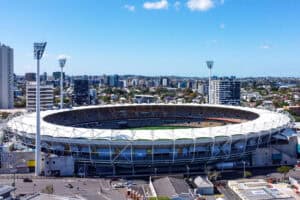

There’s a particular buzz that runs through the country when an Aussie pulls on the green and gold and delivers on the world stage. The federal government clearly wants more of those moments. On 17 June 2026, Minister for Sport Anika Wells stood up in Brisbane and unveiled a record Australian sport funding package worth $513 million, and it lands as one of the biggest commitments this country has ever made to its athletes.
Highlights include:
- $54.9M guaranteed for Para sport
- Major capital boost for winter disciplines
- $50.5M for Sporting Schools & grassroots participation
The two-year deal is built around one big idea, which is giving Australian sport the stability it needs to perform when it matters most. That means the road to the Los Angeles 2028 Olympic and Paralympic Games, the French Alps 2030 Winter Games, and, of course, the home Olympics in Brisbane 2032. This is a $513 million sport investment designed to look well beyond the next medal tally.
A Step Up From the Last Cycle
To put the number in context, the previous funding round came in at $489 million. So this is a genuine lift, not just a repeat. The extra cash is meant to lock in long-term structure rather than paper over short-term gaps, which matters when you are trying to build talent over a six-year window leading into home games.
Australian Sports Commission CEO Kieren Perkins OAM welcomed the news, thanking the government for continuing to back the athletes who, as he put it, inspire the nation. Coming from a bloke who knows exactly what it takes to reach the very top, that endorsement carries a bit of weight.
Where the $513 Million Actually Goes
Here’s the part that matters for the people on the ground. The package delivers high-performance funding across 68 separate national sports programs, so the support is spread widely rather than funnelled to a handful of marquee codes.
It also keeps the Direct Athlete Support program running, with a record $42.8 million set aside to help cover the daily reality of being an elite competitor. Training, living costs, the unglamorous stuff that rarely makes the highlight reel but absolutely decides who can afford to keep going. Anyone who follows Australian sports knows how many promising careers stall simply because the bills pile up, so this is a meaningful piece of the puzzle.
On top of that, there’s $102.8 million a year in grant infrastructure funding, free support services, and subsidised access to the Australian Institute of Sport facilities. It’s the sort of behind-the-scenes investment that fans rarely see but athletes feel every single day.
 Image Source: https://www.olympics.com.au/news/australian-olympic-committee-welcomes-government-funding/
Para Sport Locked In for the Long Haul
One of the strongest signals in the whole announcement is the commitment to Para sport. The Australian Sports Commission has ring-fenced $54.9 million over the next two years specifically for this area, which strips away a lot of the uncertainty that para-athletes have had to live with in the past.
That money flows through the Para Uplift program, which has already identified more than 150 emerging Para athletes in its first year alone. The funding will go towards better classification opportunities, proper training environments, and more specialist coaches in dedicated Para units across every state and territory. It’s the kind of groundwork that quietly turns raw potential into podium finishes.
 Image source: https://www.paralympic.org.au/2021/09/dignity-class-and-performances-to-remember-at-a-games-like-no-other/
Winter Sports Get a Cold Weather Boost
Fresh off a record-breaking showing at the Milano Cortina 2026 Winter Olympics, winter disciplines have been rewarded with a historic increase. For the first time, Curling Australia, Biathlon Australia, and Ice Racing Australia have all been brought into the national high-performance funding framework.
For a country far better known for its beaches than its bobsleds, that’s a quietly exciting development. It says the system is willing to back genuine results wherever they turn up, even in sports most of us have only ever watched at 2am with a cup of tea in hand.

Grassroots and Community Sport Aren’t Forgotten
A common worry with big elite funding announcements is that the local clubs miss out. This one tries to tackle that head-on. A total of 58 national sporting organizations will receive Play Well funding over the coming financial year, all aimed at building safe, inclusive, and genuinely welcoming places to play.
There’s also $50.5 million committed to keep the hugely popular Sporting Schools program running, along with other participation initiatives. Skate Australia and the Australian Calisthenics Federation have both been folded into the national grassroots funding framework for the first time, which is a nice nod to how broad the modern Aussie lifestyle and recreation scene has become.
What It Could Mean Beyond the Field
Now, a quick reality check. This is a high performance and participation package, not a small business grant, and it’s worth being upfront about that. There’s no direct funding line in here for local cafes, equipment shops or tour operators.
That said, money moving through community sport rarely stays put. When programs like Sporting Schools and Play Well run in towns and suburbs, local clubs tend to spend on gear, uniforms, coaches, and venue hire, and a fair chunk of that lands with small operators. And as the build-up to Brisbane 2032 gathers pace, plenty of economists expect flow-on demand across tourism, hospitality, retail, and the trades, particularly around host regions in Queensland. None of that is locked in, but it’s a reasonable bet that a healthier sporting economy lifts a few boats around it.
The Bigger Picture
Strip away the numbers, and what you’re left with is a fairly simple statement of intent. Australia wants to be competitive at LA 2028; it wants to make the most of home advantage at Brisbane 2032; and it’s prepared to fund the pathway rather than just hope for the best.
For everyday fans, that’s good news on a few fronts. More support for athletes usually means more of those goosebump moments at major events. More investment in Para sport means a fairer go for competitors who have long deserved it. And more grassroots funding means the local club down the road has a better shot at sticking around, which is really where most of our sporting stories begin in the first place.
It’s a big number with a long horizon, and the next few years will show how it translates on the track, in the pool and out on the field. For now, the message from Canberra is clear enough. Australian sport has been backed, and backed properly.