
Quick answer: reading still wins when you need deep understanding, long-term memory, or the space to think something through, while watching videos wins when you’re learning a physical skill, following a step-by-step process, or want the fastest possible overview. The reading vs watching videos debate isn’t really about crowning one permanent winner — it’s about matching the format to the job in front of you. If you’re weighing reading books vs watching videos for study, research, or professional development, the 2026 evidence still tips toward reading content for anything dense or complex, while video earns its keep for tutorials and demonstrations. Below, we unpack exactly when each format performs best, backed by current research rather than old assumptions about reading vs video learning.
With the introduction of new technology, watching videos has become a popular trend, challenging the traditional reading culture. These advancements are revolutionising the way information is presented, putting books in direct competition. Before the emergence of video technology, the science of reading was the dominant form of obtaining information, and books were hailed as the most reliable, convenient, and accurate medium.
This promoted a widespread reading culture. Libraries, found in almost every town, served as the usual place to access books. In fact, it was common for homes and institutions to have their own collections, as people recognised the value of learning from books. Undoubtedly, books have long been revered as one of the most popular sources of information. However, as technology advances, so does our way of learning.
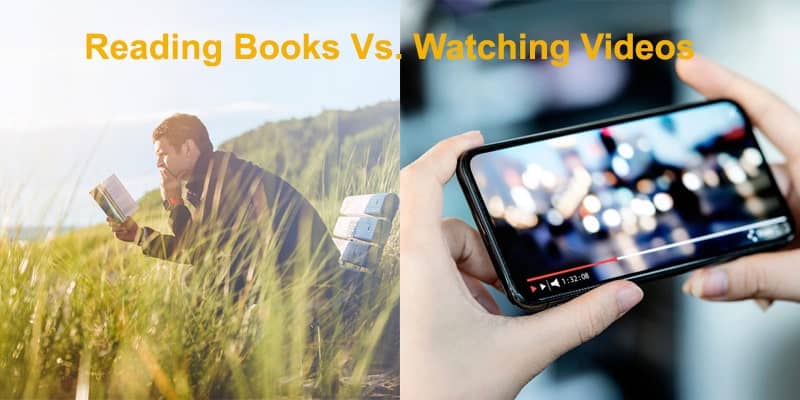
Comparison: Reading Content vs Watching Videos
| Aspect | Reading Content | Watching Videos |
| Information Retention | Higher retention through active reading and note-taking | Easier to consume but information may be forgotten more quickly |
| Learning Speed | Readers can skim, pause, and reread at their own pace | Fixed pace unless manually adjusted |
| Focus & Concentration | Encourages deep focus with fewer distractions | More prone to interruptions, autoplay, and multitasking |
| Critical Thinking | Promotes analysis, imagination, and independent thinking | Visuals can simplify concepts but may encourage passive learning |
| Accessibility | Easy to search, bookmark, quote, and reference specific sections | Finding specific information often requires skipping through the video |
| Best Use Cases | Research, academic study, technical documentation, professional learning | Tutorials, demonstrations, DIY projects, fitness, cooking, and visual skills |
Website Content Is Preferred Over Video Content

Though nowadays video content has its own value, some people prefer website content. Just as there is a preference for video among the 18–24 age range, other audiences may have a strong preference for written content.
For example, older individuals often opt for reading website content over watching videos. When targeting an older demographic, it may be beneficial to provide written content, such as a blog post. Considering the habits and needs of your specific audience is vital to preparing the right content. Website content has its value.
For older individuals, less active and slower-paced lifestyles may make reading a more accessible mode of consuming information. This is in contrast to younger individuals, who may prefer to watch quick videos during their morning commute. The consumption patterns of the audience have greatly impacted the way content is consumed nowadays — and in 2026 that gap is measurable rather than anecdotal.
Pew Research Center’s 2025 “Americans’ Social Media Use” report found that roughly half of adults aged 18–29 check TikTok daily, compared with just 5% of those aged 65 and over — a generational split that mirrors exactly the reading-versus-video pattern described above.
Reading Books Over Watching Videos
The ease of making videos today has raised real questions about whether books still hold their value. Let’s find out why reading content over watching videos still holds up so well:
Efficiency of Extracting Information
A prevalent sentiment is that reading books helps in extracting information efficiently. Videos require more time to convey the same information. When reading, if the topic is one a person already knows something about, they can skim through familiar content until they reach something new. Video content rarely affords that same quick navigation.
Control and Flexibility
The beauty of reading lies in its ability to provide complete control and adaptability. With the option to adjust the reading pace, learners can effectively absorb material at their own speed. Videos, on the other hand, often run at a fixed pace, limiting how much a viewer can customise the experience to their own understanding and comfort level.
Accessibility and Indexing
Another notable advantage of written content is its accessibility and indexing. With books, articles, and online resources, people can easily refer back to specific sections for review, search for a keyword, or bookmark a page. Videos lack the same indexing and random-access convenience, making written materials the better choice for referencing specific information later.
Cognitive Absorption and Retention
Reading has long been associated with a higher level of cognitive absorption compared with watching videos, partly because active reading demands more effortful processing than passively watching a screen. That idea holds up well against current research.
A 2026 study published in the Scholarship of Teaching and Learning in Psychology assigned participants to study material by reading text, watching video, or a mix of both, then re-studying the same way. Test performance was consistently strongest for the group that both studied and restudied by reading — the researchers pointed to the greater attention and more active processing that reading online text demands, compared with watching video.
This lines up with a well-established idea in learning science called the transient information effect: once a spoken or animated explanation has played, it’s gone, whereas a sentence on a page can be re-read as many times as needed. Cognitive load researcher John Sweller, whose original 2011 work introduced the concept, reaffirmed in 2025 that spoken and animated information is genuinely harder to retain than written material for exactly this reason.
High Engagement With Text
Another advantage of reading is the ability to actively engage with text through note-taking, underlining, or annotating. This kind of active involvement creates a more immersive learning experience for many people, something that’s harder to replicate while watching a video.
Why Learning From Video Alone Isn’t Always the Best Idea
There’s a common view that video may not always be the most effective way to learn complex topics like programming or technical subjects. Many experts believe that reading, analysing, and being able to easily revisit specific parts of a text-based lesson is a more reliable approach for anything dense. Here’s what the research — old and new — actually shows.
Video consumption has genuinely exploded, but it’s generational, not universal. The Reuters Institute Digital News Report 2025 (University of Oxford) found video’s share of global news consumption climbed from 67% in 2020 to 75% in 2025, and YouTube’s own CEO reported Shorts hit 200 billion daily views in 2025. Yet daily TikTok use is still concentrated among under-30s rather than spread evenly across all ages.
Print still edges out screens for comprehension of dense material. A landmark 2018 meta-analysis by Delgado, Vargas, Ackerman and Salmerón, covering 54 studies and roughly 171,000 participants, found a small but consistent advantage for reading on paper over screens — particularly for factual, expository content and when readers were working under time pressure. A follow-up 2025 meta-analysis found the paper advantage was strongest specifically when scrolling was required, and largely disappeared when it wasn’t — a useful nuance for anyone reading long-form content on a phone.
Extensive research conducted since 1992 by Professor Patricia A. Alexander and Lauren M. Singer reveals that students tend to have a stronger grasp of information when it’s presented in print or written form rather than video, particularly for content under a page long. Their findings, and those of the studies above, suggest that despite the push toward paperless learning, printed and text-based materials still earn their place in academic routines.
A 2013 fMRI study by Professor Gregory Berns and Kristina Blaine tracked college students reading the novel Pompeii by Robert Harris and found a notable increase in brain connectivity in areas linked to language and sensory-motor function — evidence that reading can create a genuinely embodied experience. More recent neuroscience backs this up: a 2025 synthesis covered by Neuroscience News, drawing on cognitive scientist Falk Huettig’s research, describes reading as one of the most powerful cognitive enhancers available, reshaping memory, attention, and even how the brain processes language and faces.
A 2009 University of Sussex study found that just six minutes of reading could lower stress levels by up to 68%, outperforming methods like tea or coffee (54%) and a walk (42%). More consequential for long-term health: a 14-year Taiwan Longitudinal Study on Aging, tracking almost 2,000 adults aged 64 and over, found that people who read at least once a week had roughly half the risk of cognitive decline compared with non-readers.
Back in 2018, a Harris Poll survey for Pearson found 59% of 14–23-year-olds preferred YouTube for learning, versus 47% who preferred reading. Heading into 2026, the picture has shifted again: McGraw Hill’s Student Study Trends Report found around 80% of students now use ChatGPT and social media together for study help — a reminder that reading’s real competition today isn’t only video, it’s AI-generated content as well.
When Watching Videos Genuinely Wins
None of this means video should be written off — it’s simply better suited to different kinds of learning. A randomised controlled trial with 60 medical students found that video-based e-learning outperformed illustrated text for teaching hands-on clinical skills, both immediately and a month later, even though the two formats performed about the same on purely theoretical questions. The takeaway for anyone comparing reading vs video learning: text is hard to beat for facts, arguments, and reference material, but video has a real edge whenever the goal is watching a physical movement, a process, or a demonstration unfold in real time — think cooking, fitness routines, home DIY, or software tutorials with a lot of clicking and dragging.
Final Thoughts
To sum up, the inclination towards reading over watching videos is driven by the practicality, sense of agency, and adaptability that text-based learning provides. Videos remain genuinely useful for conveying big-picture concepts, demonstrations, and practical, hands-on examples.
Reading’s capacity to quickly process information, revisit material effortlessly, and actively interact with written content makes it the preferred option for a great many learners, students, and professionals. Text-based learning still holds its own against video content in 2026. That said, the smartest approach isn’t choosing a permanent side in the reading vs watching videos debate — it’s recognising diverse learning styles and picking the medium that actually suits the content and the person in front of it.
Frequently Asked Questions
Is reading better than watching videos?
Reading is generally better for deep comprehension, long-term retention, and critical thinking, especially with dense or factual material. Watching videos is better for demonstrations, physical skills, and quick overviews. Neither format wins outright — reading vs watching videos really comes down to what you’re trying to learn and how you plan to use that information afterward.
Why do people retain more information from reading?
Reading demands more active processing than watching video, and text never disappears the way spoken or animated content does — you can pause, reread, and revisit a sentence as many times as needed. This is known in learning science as the transient information effect, and it’s one of the clearest, most consistent explanations for why the benefits of reading show up so reliably in comprehension research.
When are videos better than reading?
Videos genuinely outperform text when the goal is learning a physical or procedural skill — think cooking techniques, fitness form, DIY repairs, or software walkthroughs. Seeing a movement or process unfold in real time is simply more efficient than reading a written description of it. For purely factual or conceptual material, though, reading content tends to hold the advantage.
Does reading improve memory and focus?
Yes. Reading has been linked to stronger memory, sharper focus, and lower stress levels, with a long-term study of almost 2,000 older adults finding that weekly readers had roughly half the risk of cognitive decline of non-readers. Recent neuroscience also shows reading actively reshapes attention and memory networks in the brain, reinforcing the well-documented benefits of reading over time.
Should students read or watch videos to learn?
Students generally learn complex or exam-relevant material more effectively through reading, since it supports deeper processing and easier revision. Videos work well as a supplement, particularly for visual or step-by-step topics. The strongest approach to reading vs video learning for students is usually a blend: read for depth and understanding, then use video to reinforce tricky or highly visual concepts.