Aussies will happily pay for a decent coffee. Compare the Market put the average cost of a takeaway coffee at $5.53 in 2025. Sell 100 cups on a Saturday morning at that price and you’ve taken roughly $553 before costs. Not bad for a few hours’ work. That’s a big part of why coffee carts are so tempting. The menu’s short, the setup’s small, and you can take the business wherever the crowds are.
But it’s still a food business, and it comes with real rules. A few of them have shifted over the last couple of years, too. So if you’re keen to take a cart to markets and festivals, here’s what to get sorted before your first Saturday.
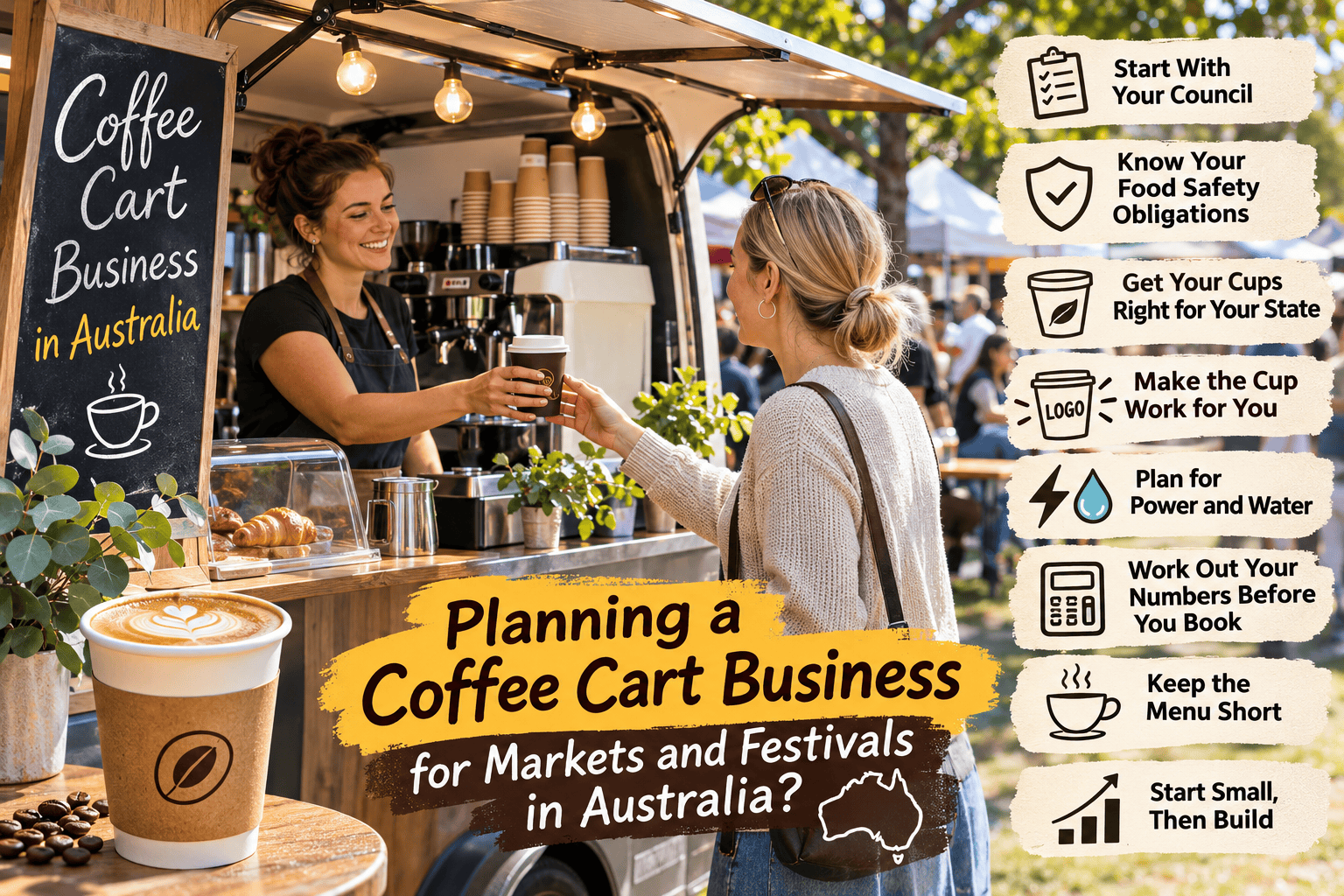
Start With Your Council
Paperwork first. The coffee machine can wait.
Food Standards Australia New Zealand (FSANZ) has a guide to mobile food businesses, and it’s clear on this point: you need to notify the council where your vehicle is garaged before you start trading. You might also need to notify other councils where you plan to work. Stalls have a similar requirement under the guidance for temporary food premises.
Why does this matter? Because a regular run of markets can cross council boundaries without you even noticing. Before you hand over money for a stall, ask each council what it needs from you. Market organisers will usually want to see your paperwork as well, and plenty of them ask for public liability insurance. Keep everything in one folder, ready to send.
Know Your Food Safety Obligations
According to FSANZ, everyone in your business who handles food needs to know how to keep it safe. You, or someone working with you, may also need formal training, such as a certified food safety supervisor. Your local council can tell you exactly what applies.
On a coffee cart, milk is the thing to watch. FSANZ lists dairy products like milk and cream among the foods that need temperature control. That sounds simple enough until you’re parked in an open paddock on a 34-degree day. Work out where your milk will live, and buy a thermometer so you can actually check it.
Then there’s the cart itself. The mobile food guidance covers the basics, like enough room to work and a basin used only for hand washing, with warm running water, soap and single-use towels. Check all of this before you buy or build. Adding a hand basin after the fact is a headache you don’t want.
Get Your Cups Right for Your State
Here’s the one most new operators miss. Cup rules now differ from state to state, and buying the wrong stock can leave you with boxes you’re not allowed to use.
South Australia’s bans that commenced on 1 September 2024 cover hot beverage cups lined with a waterproofing polymer, unless they’re certified to the Australian compostable standards AS 4736 or AS 5810. Lids need the same certification. Over in the west, Western Australia has banned non-compostable coffee cups as well. Compostable paperboard cups certified to Australian standards are excluded from that ban, and lids have to be entirely plastic free. The WA Government expected hot beverage cups to make up more than 154 million of the items saved each year under that stage of its plan. That’s a lot of cups.
Trading somewhere else? Check your own state’s rules, and ask each market organiser too, since some events set their own packaging requirements. If your route crosses state borders, keep it simple and buy for the strictest state you’ll visit.
Make the Cup Work for You
Think of your cup as the cheapest ad you’ll ever run. Once it leaves your stall, it wanders past every other stall at the market with your name on the side. Lots of small operators start out with plain cups, then switch to custom coffee cups for markets and pop-ups once they’ve landed on a logo they like and know roughly how many they go through in a day.
Keep the design clean. People only glimpse it for a second or two as it passes by, so a clear logo and your Instagram handle will work harder than a busy layout ever will.
Plan for Power and Water
Most of the problems you’ll hit on the day come back to these two.
An espresso machine and a grinder can pull a fair bit of power. Ask each organiser exactly what the site provides before you commit. Many markets offer limited power, and some offer none at all. That might mean a generator or a gas-powered machine.
Water’s the other limit. Work out how much you’ll use over a full day, including rinsing and hand washing, then carry more than you think you’ll need. And ask how waste water should be disposed of. You can’t just tip it on the grass.
Work Out Your Numbers Before You Book
Stall fees vary wildly, so test every event on paper first. Start with the fee. Add your wages, fuel, and the cost of ingredients and cups for each drink. Divide that total by your margin per cup, and you’ve got the number you need to sell just to break even.
Say a stall costs $150 for the day, and fuel plus a helper adds another $150. If each coffee leaves you $3.50 after ingredients and the cup, you’d need to sell around 86 cups before you made a cent. These figures are only an illustration, so plug in your own.
Then go to the market as a customer. Count the people. See how many other coffee vendors are there and notice where the queues build up. It’s also worth asking the organiser whether they cap the number of coffee vendors. Being the only cart on site can change your whole day.
Keep the Menu Short
A long queue is great advertising, but only if it keeps moving. For most events, you’ll be fine with espresso, flat whites, lattes, cappuccinos and one or two cold options, plus a plant-based milk or two. If you can, bring a second person to take orders while you pull shots. During the morning rush, it makes a huge difference.
Start Small, Then Build
Your first few events will teach you more than any spreadsheet. Keep track of how many cups you sell, which drinks people order most and how long your milk holds up. Then grow your regular markets bit by bit. The day someone walks right across a showground because they know your flat white is worth it? That’s when you know you’re onto something.