
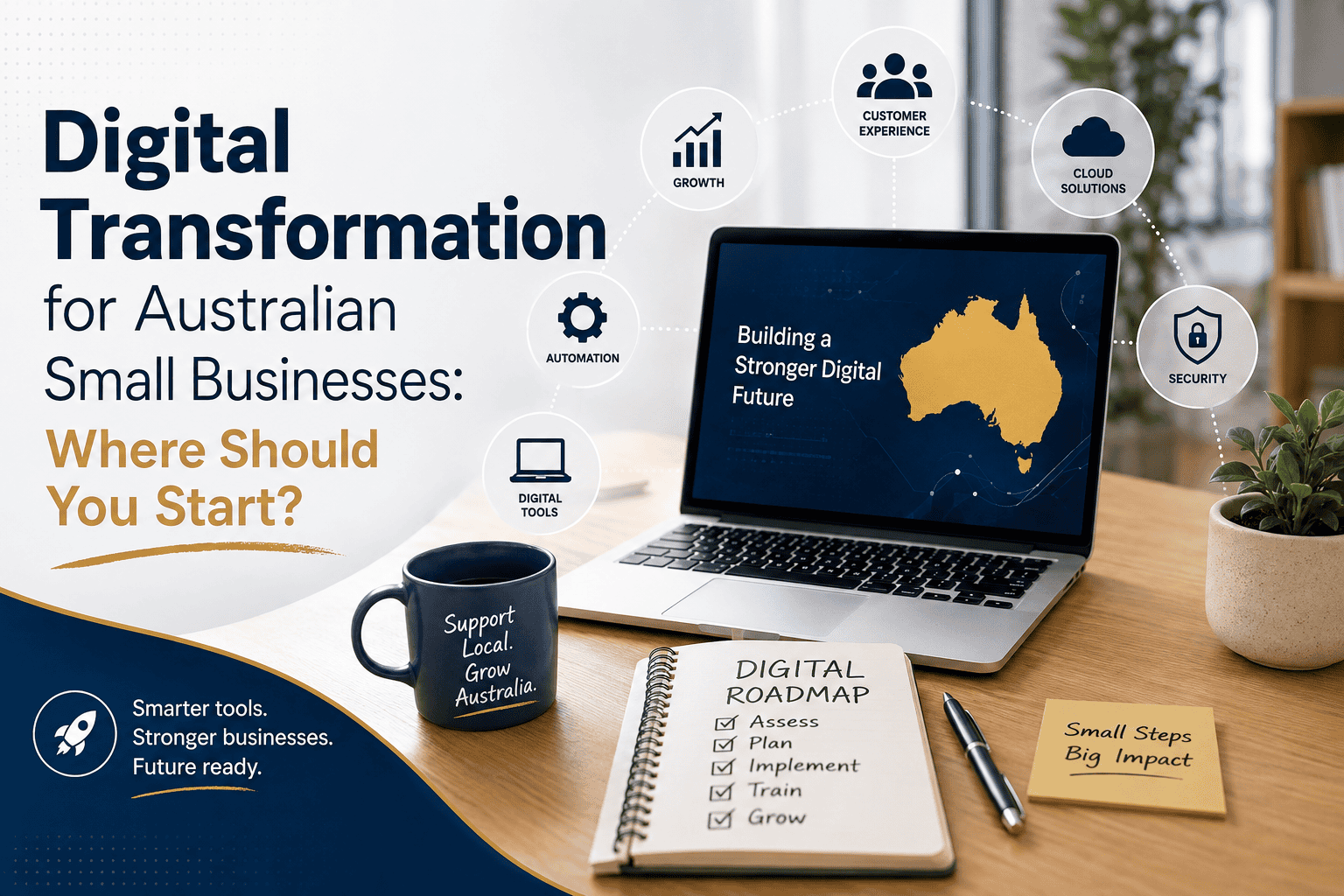
You have a spreadsheet that only makes sense to you, the folder of invoices you were supposed to follow up on, and a customer who just asked if they can pay with a card tap rather than a bank transfer. It is not a technical issue. It’s a digital transformation issue, and for most Australian small businesses, it starts smaller than you’d think.
What Digital Transformation Actually Means for a Small Business
Forget the enterprise version of this term – no IT department, no five-year roadmap required. For Australian SMEs, digital transformation means swapping manual, error-prone processes for connected digital ones: online payments instead of chasing cheques, a shared customer record instead of sticky notes, a booking system instead of a phone ringing through your lunch break. It’s targeted, not total.
Examples of Digital Transformation Strategies from Global Leaders
You don’t need Domino’s budget to learn from Domino’s playbook. Over 85% of Domino’s US retail sales in 2024 came through digital channels (SEC filing, 2025) – website, app, and voice ordering – after a decade of rebuilding around convenience rather than just pizza. The lesson for a small business: if booking still depends on someone answering a phone, you’re losing sales every time that call goes to voicemail.
Starbucks tells a similar story from the loyalty side. Mobile orders passed 30% of US transactions in 2024, and loyalty members now drive close to 60% of sales at company-run stores (GeekWire, 2024). Scaled down, any café, salon, or trades business can use the same idea: a simple repeat-booking or loyalty system captures more revenue than one-off walk-ins ever will.
Neither company transformed overnight. Both started with one system and built out from there – that’s the model worth copying, not the budget.
Signs Your Business Is Overdue for It
A few signals that it’s time to move:
You’re entering the same customer or invoice details into two or three different places
Payments happen by bank transfer, cheque, or “I’ll pop by with cash”
You have no easy way to see who your repeat customers are
Bookings, quotes, or orders come in by phone or text with no record trail
You’ve said “I really should look into that” about a piece of software more than once this year
If two or more of these sound familiar, you’re not behind – you’re just due.
Where to Start – The First 3 Areas That Pay Off Fastest
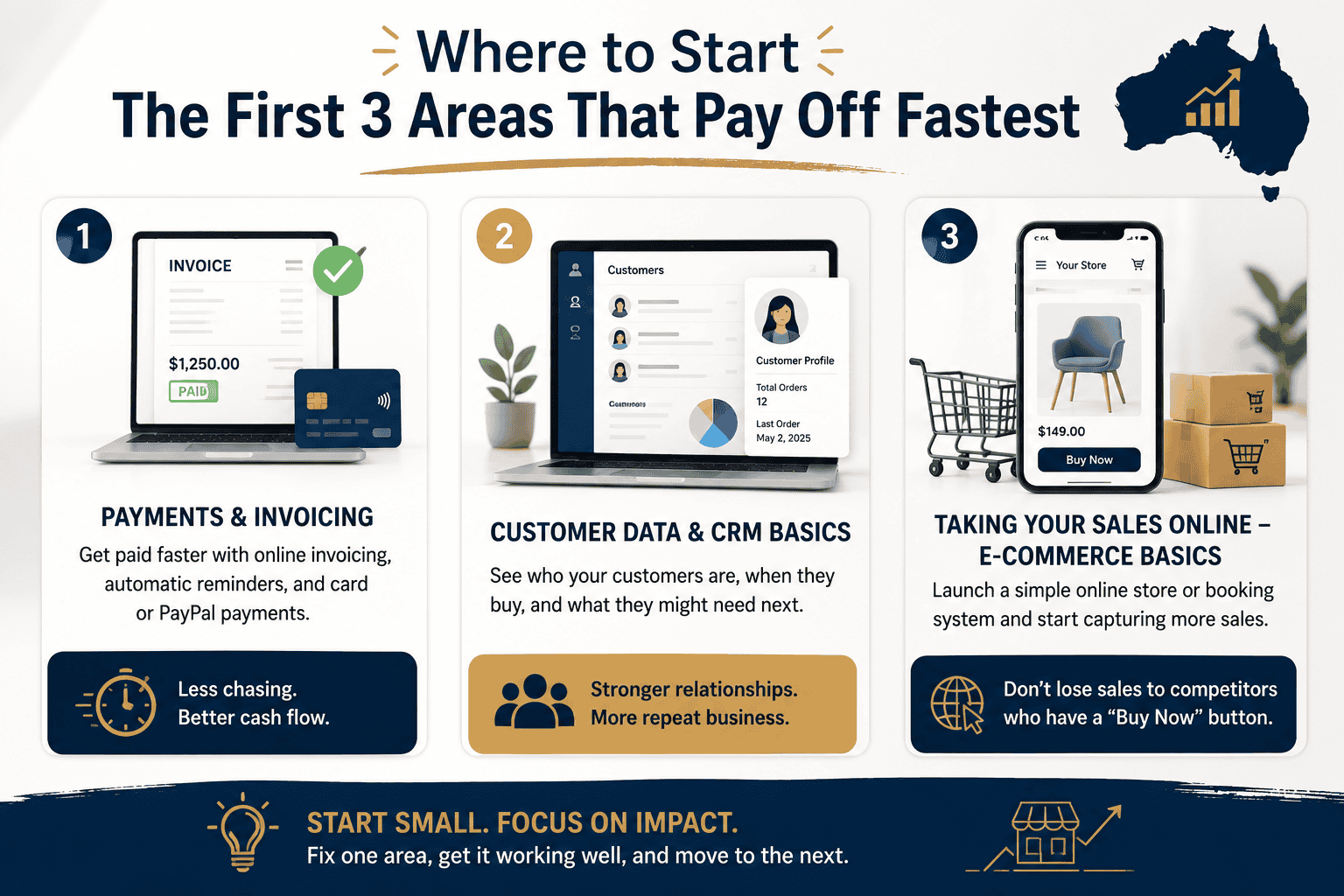
Payments & Invoicing
Late payments are a real cost, not just an annoyance. Online invoicing with automatic reminders and card or PayPal options shrinks the gap between sending an invoice and getting paid, and removes the manual reconciliation that eats an evening every week.
Customer Data & CRM Basics
You don’t need Salesforce. A basic CRM – even a well-organised spreadsheet synced to your email – lets you see who’s bought from you, when, and what they might need next. This is the single biggest gap for Aussie small businesses, and the one most directly tied to repeat revenue.
Taking Your Sales Online – E-Commerce Basics
If you sell a physical product or bookable service, an e-commerce business in Australia doesn’t need a custom-built site. A Shopify or Square Online storefront connected to your existing stock and payments can be live within a week. The goal isn’t becoming a full online retailer overnight – it’s not losing sales to competitors who simply have a working “Buy Now” button.
Common Mistakes Small Businesses Make
The biggest mistake isn’t moving too slowly – it’s buying tools before mapping the actual workflow. A new booking system doesn’t help if nobody agrees on who updates it. Other common missteps:
Skipping staff training:
Good software fails anyway if your team quietly reverts to the old spreadsheet.
No ROI check-in:
Set a date three months out actually to check whether the tool paid for itself – most companies never do, and they continue to pay for software that is never used.
Chasing every tool at once:
One well-adopted system beats four half-used ones. After fixing one workflow, proceed to the next.
Not exploring funding options:
Look into startup funding in Australia, grants, and other support programs that could help pay technological expenditures without needlessly straining cash flow if the correct digital tools need an upfront investment.
Ignoring basic cybersecurity:
Only 14% of Australian small businesses reported losing time or money due to a cyber event in 2025 (CPA Australia, 2025–26). However, keep in mind that this is partially due to the low level of digital engagement among Australian small businesses. The risk grows as you digitise, so build in basic protections from day one rather than bolting them on later.
DIY Tools vs. Hiring a Digital Consultant
| DIY (off-the-shelf tools) | Digital Consultant | |
| Cost | Low – mostly subscription fees | Higher upfront, but often subsidised |
| Speed | Fast for simple setups | Slower start, faster full rollout |
| Control | You make every decision | Shared – advisor guides the plan |
| Best for | Single-system fixes (invoicing, booking) | Multi-system overhauls, or if you’re time-poor |
If you’re only fixing one thing, DIY is usually fine. If you’re trying to connect payments, customer data, and online sales all at once, a consultant pays for itself in avoided false starts.
What It Costs (and What Happens If You Don’t)
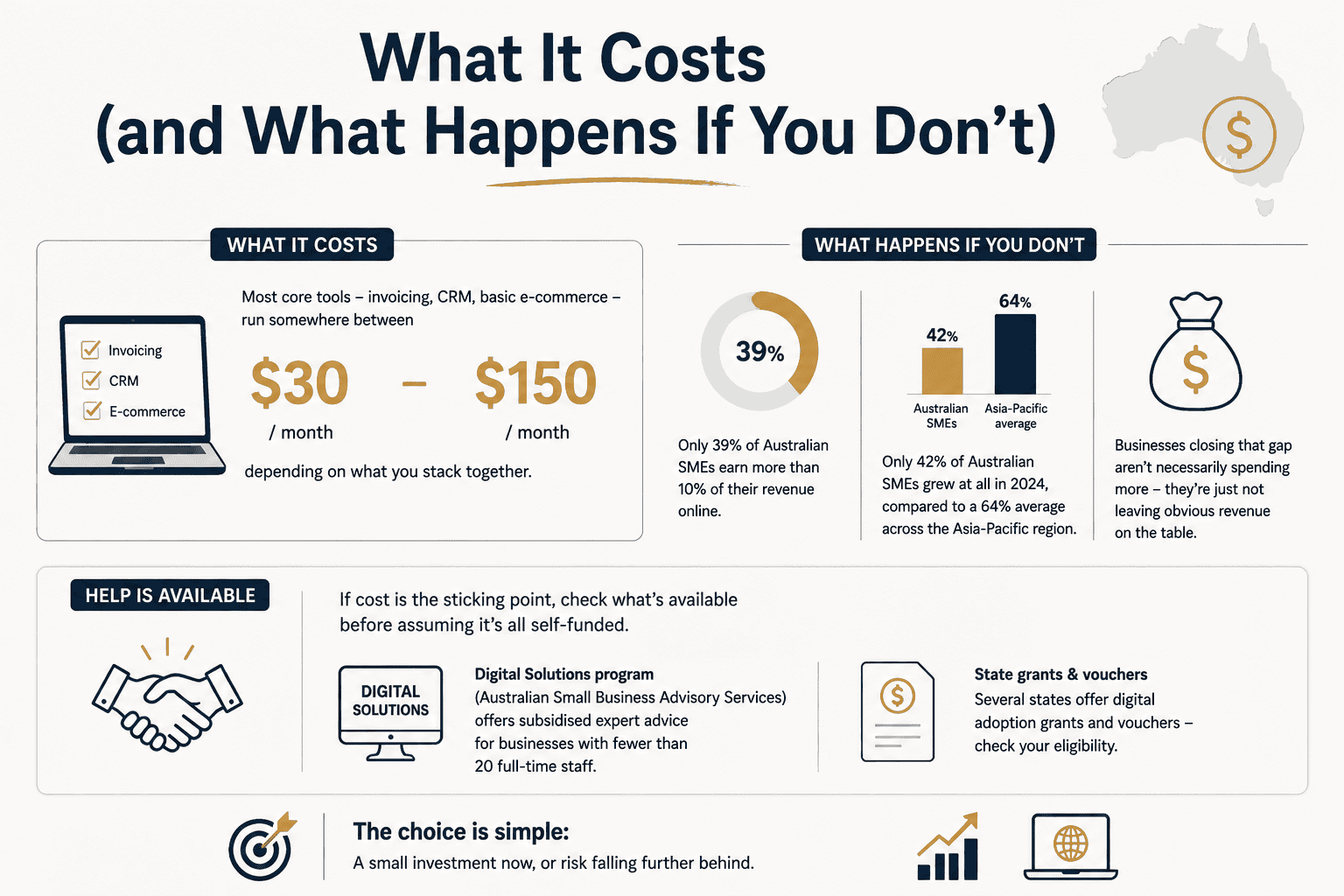
Most core tools – invoicing, CRM, basic e-commerce – run somewhere between $30 and $150 a month, depending on what you stack together. That’s a small number next to what standing still costs. Only 39% of Australian SMEs currently earn more than 10% of their revenue online, well behind regional peers, and only 42% grew at all in 2024, against a 64% average across the Asia-Pacific region (netStripes/CPA Australia data, 2024–25). The businesses closing that gap aren’t necessarily spending more – they’re just not leaving obvious revenue on the table.
If cost is the sticking point, check what’s available before assuming it’s all self-funded. The Digital Solutions program (Australian Small Business Advisory Services) offers subsidised expert advice for businesses with fewer than 20 full-time staff, and several states run their own digital adoption grants and vouchers that you can check your eligibility for.
A Simple 90-Day Starting Plan
Month 1 – Fix the leak. Pick the one process costing you the most time or money (usually invoicing or bookings) and move it online. Nothing else yet.
Month 2 – Build the record. Set up a basic CRM or customer list pulling from that new system. Start actually using it for follow-ups.
Month 3 – Go live and review. If e-commerce is relevant to you, launch a simple storefront. Then sit down and check: is the Month 1 fix actually saving time? If not, adjust before adding anything new.
Next Step
Don’t try to fix everything this quarter. Pick one item from the “first 3 areas” above, get it running properly, and give it 90 days before adding anything else.
Frequently Asked Questions
How much does digital transformation cost a small business in Australia?
Most businesses can start with $30–$150 a month for invoicing, a basic CRM, and simple e-commerce tools. Bigger overhauls with a consultant cost more upfront but often qualify for subsidised advice through programs like Digital Solutions.
Do Australian small businesses need a consultant or can they DIY it?
DIY works well for one system at a time, like moving invoicing online. A consultant earns their cost when you’re connecting several systems – payments, customer data, online sales – at once.
What’s the first tool I should upgrade?
Whichever process costs you the most hours or the most late payments – for most small businesses, that’s invoicing.
Are there government grants for digital transformation in Australia?
Yes. The Digital Solutions program (ASBAS) offers subsidised digital advice for businesses with fewer than 20 staff, and most states run their own grants or vouchers – check current eligibility before applying.
Is moving to e-commerce part of digital transformation?
Yes – for any business selling a physical product or bookable service, it’s usually one of the first three areas worth tackling, alongside payments and customer data.